Showing posts with label Legends. Show all posts

Thursday, September 15, 2011

Coconut: From the legend to modernity

@ Adolphe Sylvain

It has been a while since I last shared a legend from Tahiti & her islands with you. To me, legends are like dreams that never die, and the Polynesian culture, being mostly oral, is very rich with poetic legends... They are part of our history and also part of the myth which built the paradise...

Today I wanted to share with you the legend of Hina & the eel which tells of the creation of coconut trees. Have you ever noticed that coconuts have two eyes and a mouth? 


According to the legend, Hina, a very beautiful Princess of Papeurii of Tahiti, was destined in marriage to the king of lake Vaihiria, Faaravaaianuu. When Hina went to meet her groom, she discovered he was a giant puhi (eel). 

Frightened, she ran to Maui to ask for his protection. Maui managed to capture the eel and cut it into three. The eel' head rolled to Hina's feet and said: " From this day on, all men, and firstly you, will kiss me on the mouth. I die but you will be mine anyway"

Maui wrapped the head and instructed Hina not to put it on the ground until she got home and destroyed it or the eel's prediction would come true . 

On her way home, Hina forgot Hiro's warning and she put the head on the ground as she stopped to bathe in the river. Immediately, roots sprouted and the head grew into a strange tree which resembled a giant eel, its head erect towards the sun: the first cononut tree was born. 

After a few days, the island of Tahiti went through a period of drought and the only plant which survived was the coconut tree.The men decided to taste its nuts which also contain sweet water and Hina drank from the coconut too. On the fruit, three dark stains, resembling two eyes and a mouth could be seen. It is said that drinking from a coconut, like Hina did, is like enjoying a royal kiss which was once denied.

"And Hina kissed the eel" by Bobby Holcomb

I personally think there is nothing as refreshing as drinking an ice cold coconut water bought from the Papeete market or from one of the many stalls on the side of the road... thinking that you are somehow part of the legend is just the icing on the cake that makes it that little bit more special.

Did you know? 


@Richard Harrington

Coconut water is deemed to be one of the healthiest drinks around, not only thanks to its natural sweet flavor but also to its all-natural appeal and health benefits...and although here in Tahiti, we mainly know coconut water in its natural form, some companies have developed coconut water products ranging from pure coconut water to flavored varieties. Even I was surprised when I heard about the hype around coconut water...after all, I've been drinking it since I was a child, mainly because it tastes good and is thirst quenching... Now I was actually reading that it had health benefits...(for example, coconut water contains 5 electrolytes which help certain functions of our body) and article appeared all over the internet praising the benefits of coconut water and dubbing it "nature's soft drink", or even "life enhancer"...from being a cure for hangovers to anti-aging properties... The benefits seem to be endless. 


I must say that although some of the claims might be true, I am pretty skeptical about a few of them and I even think that sometimes, coconut water has been mistaken with coconut milk, which is most definitely not the same thing (coconut water comes from the unripped nut whereas milk is extracted from the pulp of ripped coconut). Still, I believe the greatest benefit of coconut is its ability to give you this amazing feeling of a holiday drink, a piece of refreshing paradise that can be enjoyed anytime of the day.

@Greg Le Bacon / Tahiti Tourisme

Obviously, coconut has many other uses, and coconut water is only one of them. Its pulp can also be used to make coconut milk (used in Tahiti's traditional dish, poisson cru - raw fish with coconut milk) or macerated to create monoi, the sacred oil of the gods. Coconut wood is considered to be a precious wood and makes for the most exquisite carvings and craft in general.

@Vatea Bunton

Thursday, July 7, 2011

THE MAGICAL ISLAND OF MOOREA


This heart-shaped island is also known as Tahiti's sister island as it is only a 35 minutes boat ride away. The island is reminiscent of James Michener's south Pacific exotic paradise island, Bali Hai and most visitors agree: the beauty of Moorea is unforgettable.

Friday, June 17, 2011

HEIVA I TAHITI: POLYNESIA CELEBRATES JOY

@ Heiva Nui

The Heiva i Tahiti, celebrated every year during the month of July is more than just a festival, it is the pinnacle of cultural effervescence in French Polynesia.

The Heiva drags us back to the roots of Polynesian tradition, where legends and myths were born, and, for a moment, the entire population is invited to celebrate the revival of our culture.

From ancient times...


The arrival of the first Europeans and missionaries in the 18th century marked the decline of Polynesian art forms from the carving of tiki, to tattooing and dancing. Indeed, the dances were perceived as erotic and labelled as debauchery and prohibited in the name of  "teaching the untutored savage...and civilise and elevate him in the scale of humanity".  Undeniable sign of two completely disparate cultures coming together but also the announcement of the colonial reign and domination.


"A Dance in Otaheite" (Tahiti, Captain Cook's voyage) engraved by Heath after a picture by Webber, published in The Geographical Magazine, 1793 


At the beginning of the 20th century, tahitian dancing progressively makes it resurgence although the vahine are still prisoners of long missionary dresses and in 1881, the first Heiva i Tahiti takes place.

Tahitian woman in festive costume c. 1906

The resurgence of traditions marks the beginning of the Polynesian enlightenment, the resurgence of Polynesian arts with a contemporary twist. Two cultures had met, one trying to annihilate the other, but failing, and one culture was born which is a modern blend of both.

...to modern times.


2011, 129 years of celebrations, dances, singing, legends, spear throwing, stone lifting, canoe races, games and competitions will take place for the greatest pleasure of all. The Heiva and its palette of warm colors, the Heiva and its explosion of sounds... the meeting of creativity and tradition, passion and conviction, power and grace.


 @ T. Salmon / Tahiti Tourisme

 
                                  @ Grégoire Le Bacon / Tahiti Tourisme           @ Florian Cherreard / Tahiti Tourisme

 @ Florian Cherreard / Tahiti Tourisme

Bodies are submitted to the most demanding exercises, whether it is the gracious undulations of the dancers moving to the cadence of the music, the percussion musicians playing to a furious rhythm, the powerful bodies of the athletes, modern warriors showing their strength, ability and precision.


                               @ Lucien Pesquiz / Tahiti Tourisme                       @ T. Salmon / Tahiti Tourisme

                            @ Raymond Sahuquet / Tahiti Tourisme                    @T. Zysman / Tahiti Tourisme

@ Gregory Boissy / Tahiti Tourisme


The Heiva tells a story and in the gestures of the dancers, legends are reborn. Between seduction and decadence, the ballets are spectacular; they tell the past and the present of the Polynesian soul, traditions on a live canvas of modernity.


An outburst of emotions, effervescence, enthusiasm, frenzy, pleasure, passion, excitement, the Heiva celebrates the beauty of life and the joy of living of an entire population.

Sunday, June 5, 2011

BLACK PEARLS: THE GIFT OF GOD TO TAHITIAN BEAUTIES


Black pearls, Tahitian pearls... exotic names for a unique natural treasure which can be found in the turquoise waters of Tahiti and her islands: the legendary poe rava, born from the sea only to please the kings and queens of Polynesia.


As Pearls are the official birthstone of the month of June (as adopted by the American National Association of Jewelers in 1912), it is only natural that my first post of the month be dedicated to this gem from the ocean.


Black pearls, symbol of chic and refinement

A symbol of mystery, grace and beauty, pearls can be surprising, enchanting, sensual, seducing, delicate and exotic, like the women wearing them. Throughout times, the timeless refinement and chic of Tahitian pearls have seduced royalty, celebrities and fashion icons throughout the world. 


Black pearls are black, right?

WRONG! Pearls are not actually black; they come in every colors one can imagine and capture the iridescence of colors of the rainbow, which could explain the legends that says that pearls originate from the meeting of the rainbow with the earth (Irish legend I wonder?)...Pearls can be dark grey, light grey, green, blue, purple, pink, even gold. The chromatic spectrum is amazing and one can spend hours deciding whether they prefer the aubergine (purplish black), peacock (greenish black), lavender (bluish black), silver (grey), champagne (yellowish grey), orient grey (surface iridescence), Tahitian gold (golden black) or the pink luminescent.


Tahitian pearls, tourism and shopping


From the sea to the jewel

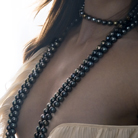
You can visit the numerous jewelers on the islands or even the market in Tahiti and decide whether to go for a jewel or for a loose pearl. In doubt, a long pearl strand is always a safe bet ladies.


While you are here, don't just buy a pearl, take the opportunity to visit the pearl farms of the Tuamotu or Gambier islands, it will be a great opportunity to learn about how pearls are born and then collected.

If you are in Papeete, make sure you visit the Robert Wan Pearl Museum for a bit of history.


A trip to Tahiti would be incomplete without a black pearl in your suitcases, yet choosing the right one can be tricky...indeed those unfamiliar with black pearls think they all look the same. It's like saying all diamonds are the same. Pearls are mineral gems produced by oysters (Pinctada margaritifera) - Te Ufi in Tahiti - as a result of their natural defense system against any foreign intruder. As such, each pearl is unique and differs from the others in terms of diameter; luster, shape, surface purity and color. 


The Tahitian pearls are world renowned, indeed, the queen of pearls or pearl of queens has long attracted the most beautiful women as well as some of the most famous jewelers around the world who celebrate the beauty of this gem and the islands where they are born, from Cartier , Van Cleef & Arpels, Mikimoto, etc.


Men and black pearls

Pearls are becoming increasingly popular among the male population and entire jewelry line are now dedicated to men, so no excuses gentlemen, you may also find something for yourselves!


and wait 'til you hear about the legends behind pearls, you'll definitely want to lay your hands on a couple, or more.


Symbolism, myths and legends throughout the world:

No matter the culture or country, the legend or the myth, pearls have always been associated with great virtues. Pearls are thought to offer the power of love, money, protection and luck, to give wisdom through experience and to cement engagements and love relationships. 

The Greeks and the Romans thought that pearls are born from rain or dewdrops collected by oysters; according to Persian mythology, pearls are the tears of the gods, whereas to the ancient chinese, pearls originate from the moonlight.

In ancient Greece, pearls were the symbol of love and marriage; wearing them was thought to promote marital bliss and prevent newlywed women from weeping. To date, pearls are often the best choice of gifts to brides at weddings or given for the 1st, 3rd, 12th and 30th wedding anniversaries.

The Arabic legend says: Dewdrop fallen from the sky on a fullmoon night take into the deep sea a bit of the wonderful light from the star that counts our time.

According to a legend in Ceylan, the tears shed by Adam and Eve created a lake: in this lake, white and pink pearls were born from Eve's tears and the more precious and rare grey and black pearls were born from Adam's tears.

In ancient Lore, wearing black pearls helped you know yourself and become prosperous. Blue Shades help you find love. Gold tones bring wealth while pink tones will earn you fame and fortune.

When I was looking for a lucky charm and asked a friend of mine what, in Polynesian culture, was considered to be a symbol of luck,  she told me I should find a pearl and keep it close to me. When I told her I already had several pearl jewels, she said that the pearl should be perfect and un-pierced. Indeed in Polynesian culture, pearls have always been associated with purity, perfection and power. 

An ancient Polynesian legend has it that Oro, god of war and peace, came down to earth riding a rainbow and fell in love with the princess of Bora Bora. As a token of his love, her gave her the first pearl produced by Te Ufi.


Sunday, May 8, 2011

MUST SEE IN TAHITI: DISCOVER THE LEGEND BEHIND THE THREE WATERFALLS

Exploring Tahiti is not just about seeing beautiful landscapes. There is much more to a trip to paradise than just bringing back beautiful pictures. The beauty of Tahiti and her island also lies in her legends, tales from far away times passed from generation to generation recounting the history of the creation of our islands.

Knowing the legends behind Tahiti's must-see sites will enhance your experience to make it magical, almost a voyage into the past of our islands.

The three waterfalls of Fa'auruma'i in Ti'arei, on the north-east of Tahiti, are one of the must-see sites of the island. The lush green vegetation of the valley against the black basalt rock walls create a breathtaking atmosphere and a total immersion into nature.

A completely different experience from the tropical beaches and blue lagoons, the stroll to the waterfalls is an adventure and swimming in the refreshing pools is a unique experience. When you reach the waterfalls and look at the water gushing from the rocks, ponder on the legend of Fa'uai and Ivi and the story of the birth of the three waterfalls. Some would say a tragedy, I would say a beautiful love story. Every time I  visit the cascades, I listen and try to hear Fa'uai's enchanting voice singing and I wonder if I, too, will encounter the spirit of the valley.

Beautiful vahine at the three cascades - Photo by Greg Nagel

The legend of the three waterfalls:


A very very long time ago a young girl called Fa'uai lived in the district of Ti'arei, on the island of Tahiti. She was the most beautiful girl in the district: her long raven hair cascaded down her back, her supple hips undulated with each step she took and her eyes were as clear as a spring. Her laugh chimed like thousands of water drops and her singing elated hearts. When she danced, she was as light and graceful as a bird. But what she loved above all was to go up and down the valleys and rivers. She knew every single corner, where to find the most beautiful flowers and ferns to make magnificent and fragrant head crowns. She also knew the power of plants which could cure and were to find them.


Fa'uai was 17 years old and she was the daughter of the great chief Marura'i. He was cruel and punished by death whoever disobeyed his orders. Nobody dared going against his will and even his daughter feared him.

He loved her more than anything. He had such love for her that he wouldn't let any man approach or talk to her. She was taboo. Extremely jealous, Marura'i had her under constant surveillance and his two best warriors escorted her on all of her strolls.


One day, Fa'uai and her friends went in the valley to pick flowers and ferns in preparation of a great feast. On the path, they encountered a handsome young man, Tua, a playful and fiery boy. He didn't know about the taboo on Fa'uai, he dashed towards Fa'uai with a mischievous laugh and snatched the fern head crown she was holding in her hand and ran off. 

Fa'uai and her friends remained petrified. Without hesitation, the two bodyguards went after him, caught him and killed him

Back at the village, Fa'uai was affected by the event and felt responsible for Fa'uai 's death. She went to stay with her mother who was ill. As her mother's illness got worse, Fa'uai went back into the valley with her friends to gather medicinal plants to cure her.  

In the valley, they encountered another boy called Ivi. He was very skinny and was actually looking for medicinal plants to treat himself. Fa'uai wanted to help him. She told her friends to go into the bushes and scream to attract the guards.

When the guards had left, she joined Ivi, who became even paler. Fa'uai told him she wanted to help him find the plants to help him get better. Ivi was scared because he knew of the tabu and didn't want to get killed like Tua. She convinced him to follow her and they edged their way between the bushes into the forest. 

When the guards realized that they had been tricked and that Fa'uai had disappeared, they started looking for her. Ivi was exhausted and became frightened by the idea that they were being pursued. He told Fa'uai to leave him alone to die and go back to the guards. The princess refused and told him she would remain with him, and that if he died, she would die with him. She wanted to stay by his side come what may.

Hearing these words, Ivi decided to reveal his secret to Fa'uai and told her that he was the spirit of the valley and metamorphosed into a handsome young man. But the guards had gotten closer and were about to catch them.

Ivi told Fa'uai that they were going to be together forever imprisoned in the waterfalls. Suddenly, they heard a deafening noise. Two enormous masses of water were pouring down on the walls of the mountain, entirely covering Ivi and Fa'uai. When the guards arrived, they discovered two magnificent waterfalls, clear water running down the cliff and collected in two beautiful pools. I The two waterfalls were named Haamaremare rahi e Haamaremare iti. It is said that since that day, Ivi and Fa'uai live happily, hidden behind the waterfalls.

The three waterfalls

On their way back, the guards were also covered a third waterfall which is called Vaimahuta.

Since then, the valley is called Fa'auruma'i.


Legend translated by the author of the blog

Friday, April 15, 2011

MONOI: THE BEAUTY SECRET OF TAHITIAN WOMEN


@Institut du Mono'i

The weather has been amazing for the past few weeks here in Tahiti... Living in a place where it's summer all year round, you sometimes forget the simple joy of a sunny day. As I know most of you are heading towards winter, I thought I’d share a little secret with you so you too can enjoy a bit of my paradise all year long. If you can’t come to Tahiti (yet), bring Tahiti to you, wherever you are.
When I lived in Europe, I missed my paradise islands, especially during those long cold winter months, so I always had a bottle of Mono’i oil with me. It was a bit of paradise in a bottle.

For those of you who don’t know Mono’i, keep reading, you are going to absolutely want a bottle or two! For those of you who think you know Mono’i, keep reading, you might learn something new.

Did you know?
As natural oils are the newest trend in skin and hair care, Mono’i is becoming a hot product on the beauty scene and today more than 250 beauty brands (among them names such as Chanel, Dior, Mac, Schwarzkopf, Estée Lauder, Nars, to name just a few) use Mono’i de Tahiti as the signature ingredient of their creams, hair products and even lipsticks or foundations.


Nars Monoi Body Glow, voted one of the 5 sexiest beauty products
So

what's all the fuss about?
For centuries, the beauty of Polynesian women has been at the center of travelers’ accounts upon returning from Tahiti and at women all over the world have been trying to uncover the secret to the vahine’s legendary beauty. How could they too have smooth golden skin and long shinny hair? Once again, this ancient secret can be found in our legends, in our culture, in our nature, in our legacy: Mono’i, the sacred perfumed oil. This miracle oil is a unique blend of fresh Tiare (gardenia taitensis) flower essence, known for its soothing and purifying properties, and refined Polynesian coconut oil. Another great tradition which was once a privilege of the arii, the Polynesian royalty and remains part of our everyday way of life.

@ Institut du Mono'i

The legend of Mono’i

It is said when Tane was born, he had the appearance of a giant jellyfish, a shapeless mass. So his father Ta’aroa, the god of creation, used Mono’i to give Tane a perfect skin, and turn him into a man of infinite beauty, making him the the god of beauty and of all beautiful things.

The traditional uses of Mono'i
This elixir of the gods not only has a divine intoxicating smell which will transport you to far away islands and white beaches, it also has myriads of unique exotic properties. In addition to being used in sacred rituals by priests, Mono'i was used essentially as a skin and hair cosmetic, but also as part of traditional medicine. Women used it as a moisturizer for their skin and hair as well as an alternative to perfume. It was also used in traditional massages on both newborn and adults. Basically, Mono'i seems to have all the qualities one could hope to find in a product: moisturizing, protective, nourishing, aphrodisiac, therapeutic, etc.

h
@Mono'i addict


Mono'i in the modern world
One could think that Mono'i would have been relegated to the status of a grandmother's remedy and forgotten. Yet, as many of our traditions, it has found its place in our modern lives. The traditional uses have been preserved and cosmetic companies around the world have revisited Mono'i de Tahiti to create new products and rituals with this exceptional oil in the era of wellbeing.

Fun with Mono'i
So you still think Mono'i is not for your? Wait, I haven't finished. If you are not into spa treatments, wellness and cosmetics in general, there are other ways you can enjoy Mono'i! Here are a few examples:

Mono'i Battle: take a few paintball guns or water pistols, add two teams of modern warriors, put them on a white sand beach and let the fun begin! 


  • Cosmetic Academy: an original concept introduced by the Laboratoire de Cosmétologie du Pacific Sud, this competition invites aspiring creators to discover the universe of cosmetic products and try to create an original product with Mono'i as its main ingredient. A fun and great way to discover all the different Polynesian products and types of Mono'i available. The contest is open to French residents with the possibility of winning a trip to Tahiti & her islands. See the creators live on www.labtv.pf

  • The Mono'i route: the first tourist road dedicated to Mono'i in Tahiti, with an itinerary of 22 "à la carte" stops, embark on an unforgettable discovery of nature, culture and the art of caring for you skin and hair.
@Institut du Monoi
A few things you should know 
  • Make sure you're buying the proper stuff! Many people buy oil calling itself Mono'i thinking that they are getting their paradise in a bottle only to discover that the oil they bought wasn't even made in Tahiti! Before buying, make sure the stamp of Appellation of origin is on the bottle!
@ Institut du Mono'i

  • Temperatures below 20°C cause Mono'i to solidify, DO NOT PANIC! Just place your bottle in the sun or under warm water and it will liquify again. The quality will not be affected.
If you know of any other fun or original ways to use Mono'i, please share with us!


Still not convinced that Mono'i should be on your must have list of beauty products? Find out more about Mono'i on these sites:


Wednesday, April 13, 2011

TEAHUPO'O: A SURFER'S PARADISE

As the swell is pumping at the moment here in Tahiti, I thought surfing would be a perfect subject for today's post.


In Tahiti Iti, where the road ends, on the East coast, visitors looking for lush and abundant nature will find a more preserved territory where the elements are both generous and excessive, to be admired and to be feared. In this part of the island lies a small fishermen’s village: Teahupo’o. 

The origin of the name Teahupo’o is ominous; in ancient times, after a famous battle, the victorious warriors decapitated their opponents and built a wall (ahu) with their heads (upo’o) to honor Oro, god of war and fertility. It is thus no surprise to find such rage and power in the waves of Teahupo’o, great roaring walls of water, an echo to the legend and the screams of the warriors who once fought and died here.


The name is world famous... Indeed, “Chopes” (for those in the know) is one of the must-surf offshore spots of the planet thanks to its “mythical wave”. Today, Teahupo’o's modern warriors are no less than Kelly Slater, Laird Hamilton, Michel Bourez, Mike Stewart, Andy Irons, Manoa Drollet and countless other great names of the surf circuit, as well as the children from the village who surf on the shore dreaming that someday their name will be next to their idols'. 


One of the greatest battles to take place in Teahupo’o nowadays is the yearly Billabong Pro WCT competition which sees the best surfers of all time rival each other for the world title with hundreds of spectators gathered to witness history being made and new legends written. 

Some of the greatest moments in the history of Teahupo'o:

 The Ultimate Wave Tahiti 3D staring Kelly Slater and Raimana Van Bastolaer:


Laird Hamilton's Millenium wave:


 Manoa Drollet surfing the biggest wave ever in Tahiti:


Please share your memories and impressions of Teahupo’o with us.

LinkWithin

Related Posts Plugin for WordPress, Blogger...